Food industry ERPs are late to AI, and they will stay late. This is not a competence problem, it is a craft problem: an ERP is built to record reliably, while AI demands fast iteration on data the ERP does not hold. Both layers are necessary.
This article is written for directors of food and drink SMEs who already run an ERP, who watch their vendor announce artificial intelligence features, and who wonder whether they should wait. The answer comes down to four structural reasons, and none of them will disappear with the next release.
Key takeaway
the ERP lag on AI is not a passing phase. It comes from four design constraints: an architecture built to record, a release cycle counted in years, a project-based business model, and a data perimeter closed on internal information. Those constraints are exactly what makes an ERP dependable, which is why they will not be lifted.
Why ERPs are behind on AI: four structural reasons
Let us set aside the wrong explanation first. Food industry ERP vendors lack neither engineers nor domain knowledge. Some of them carry forty years of traceability rules, use-by date handling and cost price calculation inside their code, and no startup will reproduce that. Their lag comes from somewhere else.
1. An architecture built to record, not to predict
An ERP is a transactional system. Its mission is that an order entered today is still the same order six years later, during an IFS audit. Everything in it is modelled for consistency: normalised tables, integrity checks, user-level permissions.
AI works the other way round. It needs long series, denormalised data, histories kept with their anomalies, and it produces probabilistic results. Grafting that logic onto a transactional core is not an update, it is a second architecture to build and maintain in parallel.
2. A release cycle in years against a technology that moves in quarters
An ERP vendor ships one major version a year, sometimes fewer. Between the product decision and the actual deployment at a customer who validates every upgrade with production at stake, eighteen months easily go by. That is the right way to run a system that must never fall over.
Over the same period, AI models have changed generation several times. A module specified eighteen months ago therefore arrives already dated, not through negligence, but because the pace of the platform and the pace of the technology are not comparable.
3. A business model built on projects, not on iteration
ERP economics rest on licences, maintenance and configuration. Value is created at deployment, and the system should then move as little as possible: every change costs the vendor and the customer alike.
Useful AI works in exactly the opposite way. It is tuned continuously, corrected when it gets things wrong, enriched with new sources every quarter. It is not a deliverable, it is a service that lives. Asking that regime of an organisation built for stability means asking it to work against its own model.
4. A data perimeter closed on the inside
This is the most decisive reason, and the least discussed. An ERP only knows what has been entered into it: orders, stock, production, accounting. That is already a great deal, and it is not enough.
Most of what moves your margins sits outside: the pork price on the Plérin market, the glass price a supplier just announced, the weather that shifts a season, the weak signal a salesperson noted after a visit. An AI module locked inside the ERP will never see those, because by definition they are not there. We cover this in our article on the data an AI agent must cross-reference beyond the ERP.
That outside layer is what we have been building from day one: raw material prices, customer ordering rhythms, signals from the tools your teams use daily. It is what separates a useful alert from one more chart. Take 30 minutes with us and let us look at what your own data would say once cross-referenced with what happens outside.
AI is not one more IT module
There is a deeper reason behind the gap, and it explains why the catch-up will not happen. A classic IT project is specified, built, tested and then maintained. You know in advance what the software must produce, and you check that it produces it.
AI does not work like that. Its output is not a feature, it is a judgement: this reference will run short, this customer is drifting away, this margin is about to erode. A judgement cannot be signed off once and for all. It is measured week after week, corrected, and retrained on what actually happened.
That craft demands a rare mix: data, models, and a precise knowledge of the sector. Knowing that a shortage on a seasonal range cannot be recovered, that a mishandled year-end rebate eats an annual margin, that a material yield drifting by two points shows up in purchasing before it shows up in the accounts. It is a field job as much as a technical one, and it is not the job of a business software vendor.
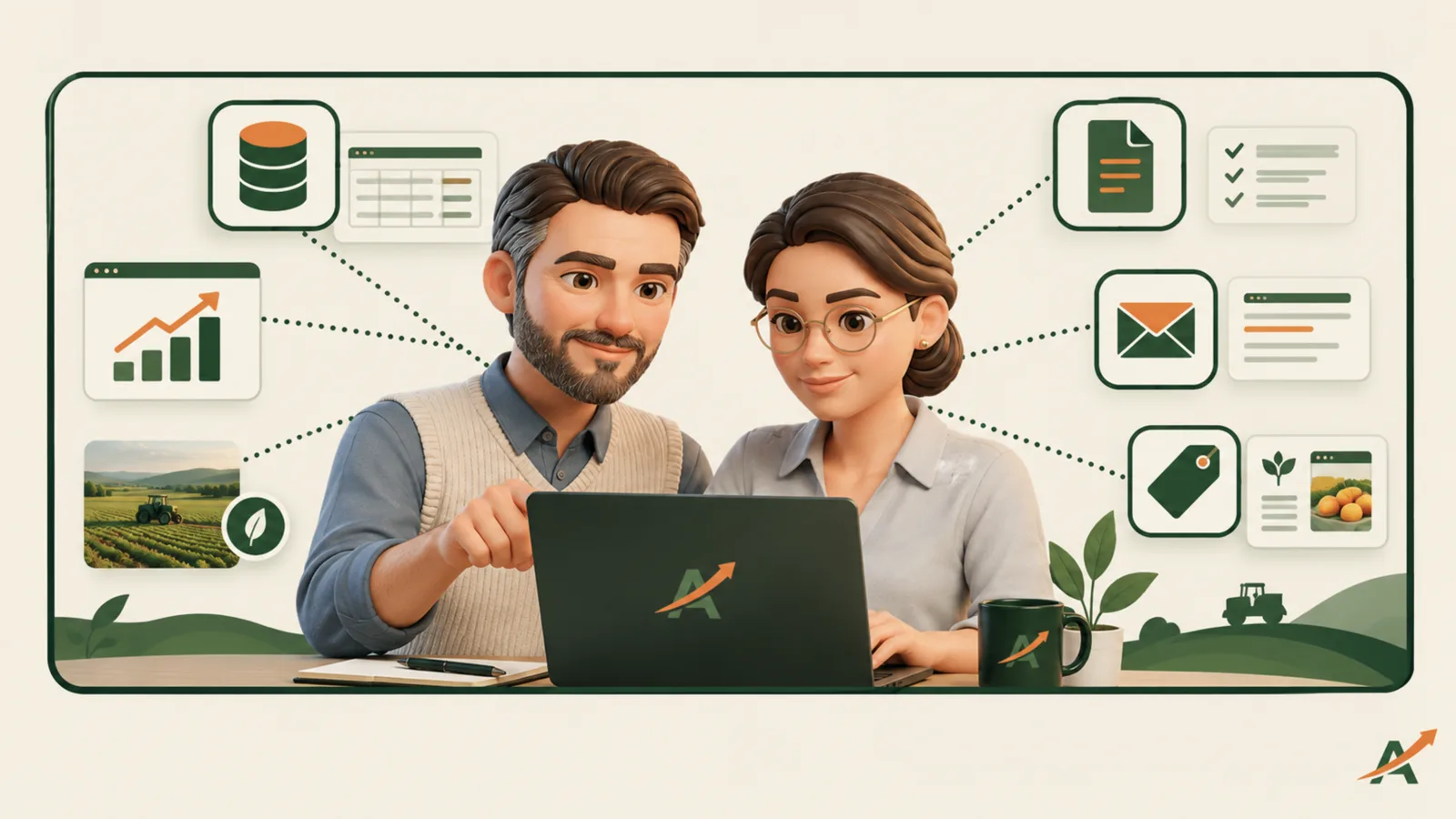
It is, however, ours, and the only one we do: no retail, no general manufacturing, food and drink only. Marc and Sophie, our two agents, know nothing other than how to watch a food business, and that is deliberate. Thirty minutes are enough to judge for yourself.
Key takeaway
the question is not which vendor will ship the best module, but understanding that the system which records and the system which decides do not obey the same laws. Forcing both into one product weakens both.
What vertical AI doesn't do, and what ERPs will always do better
A thesis is only worth as much as what it admits it does not cover. Here is the other side, with no indulgence for our own camp.
Vertical AI does not replace your ERP, and does not try to. It handles neither your batches, nor your upstream and downstream traceability, nor your production orders, nor your accounts. If your management foundation is shaky, no layer of intelligence will fix it. The right order never changes: a solid ERP first.
It does not correct wrong data. A poorly maintained order history produces false alerts, and a false alert costs more than no alert at all, because it destroys the team's trust. Data quality remains a prerequisite, which we cover in our article on data governance before any AI project.
It does not decide for you. It suggests, ranks and alerts. The decision to chase a customer, bring a production run forward or renegotiate a price stays yours, and that is exactly as it should be.
System of record and system of decision: why vertical AI solutions win
The two layers share neither the same role, nor the same pace, nor the same quality criterion. Confusing them is the expensive mistake.
| Criterion | System of record (ERP) | System of decision (vertical AI) |
|---|---|---|
| Role | Record, secure, trace | Interpret, alert, suggest |
| Pace of change | One major release a year | Continuous iteration |
| Data perimeter | Internal to the company | Internal, market and field |
| Quality criterion | Consistency and auditability | Accuracy of the suggested decision |
| Expected lifespan | Ten to twenty years | A few months per model |
Read through that table, the debate changes nature. It is not about picking a side, but about accepting that nobody can excel in both columns at once. The companies that will pull ahead are those that keep a solid ERP and connect a specialist of their own sector to it.
This is not a theoretical position. CETRA informatique, the publisher of EURAGRO for more than forty years, made exactly that choice: rather than building its own AI layer, the vendor preferred to open its ERP to a player whose craft that is. Our customers who use both tell us the same thing, and it is the best summary of this thesis: they do not want to give up either one. The ERP holds the house together, the agent watches what nobody has time to watch. What that looks like week after week is detailed in our article on what the EURAGRO integration changes in practice.
Connecting that layer requires no ERP change and no multi-month integration project: read access is enough, through API, export or direct database. And the price is published openly, per month, rather than quoted per project.
What this changes for a food industry SME that already runs an ERP
Stop waiting for your vendor's next release. Waiting has a real cost, measured in customers lost without warning and margins given away on price rises spotted too late. Meanwhile your teams already use AI on their own: 55% of French micro-businesses and SMEs reported using generative AI at the end of 2025, against 31% a year earlier and 15% in 2023, and those uses remain largely unframed by the company, according to the Bpifrance Le Lab barometer.
Judge a supplier on what it connects to, not on its demo. The useful question is not whether the tool looks impressive, but whether it reads your ERP without forcing you to change it, and whether it goes out to fetch the market data you lack. Our comparison of AI agents for the food industry scores the four families of solutions on that criterion, among others.
Insist on knowing where your data goes, and in which direction. Read access, a perimeter you choose, hosting you know about. That requirement costs nothing to set at the start and becomes very hard to impose later.
Those three decisions are easier to take in front of a real case than in front of an article. Book 30 minutes: we start from the ERP you already have, and look at what it is not telling you today.
Frequently asked questions about AI and food industry ERPs
My ERP announces a module with agentic AI, is that enough?
It depends what you expect from it. To automate internal tasks such as data entry or document generation, an AI module built into the ERP does the job. To anticipate a drop in orders or a margin drift, it lacks the data that sits outside the ERP, and that limit is not fixed by an update.
Do I need to change ERP to do AI?
No, and it is rarely a good idea. Changing ERP mobilises your team for months with no short-term management gain. An AI layer connects to the existing ERP through API, export or database. If your ERP serves you well day to day, keep it.
How many suppliers does this add up to in the end?
Two are enough in most food and drink SMEs: the ERP that holds operations, and a vertical player that holds the decision layer. Beyond that, every extra tool adds an integration to maintain and an invoice. The useful question is what each component sees that the others do not.
Who remains responsible for my data in this setup?
You do. The AI supplier accesses a perimeter you define, in read mode, and has no business becoming a second place where your data lives. Check three points in the contract: the direction of the flow, the hosting location and reversibility. These are the same requirements as for any IT supplier.
Wouldn't a general-purpose AI agent do the job?
A general-purpose tool ignores your sector constraints: use-by dates, material yields, seasonality, year-end rebates, the ordering cycles of retail chains. It answers well when asked a question, but it does not know which question to ask. That is the difference between a writing assistant and an agent that watches your business.
Where to go next
If you want to understand what an agent actually does once connected, start with our overview of AI agents in the food industry, which covers the business uses one by one. You will see that value never comes from the technology itself, but from what it is connected to and the decisions it triggers.
And if you want to see what it would look like at your company, book 30 minutes with us: we look at your ERP, what it already holds, and what a vertical agent would see in it that you cannot see today.
Ready to take control of your data?
Book a 30-minute demo and see what Agrolytics can do for you.
Book a demo