Why this subject deserves clarifying
When people talk about artificial intelligence in the food industry, the articles in circulation deal almost exclusively with precision agriculture, sorting robots in factories, or connected sensors on production lines. These are real and important subjects — but they mainly concern large industrial groups and farms, not the SME leaders managing a customer portfolio, raw material purchasing, and profitability under pressure.
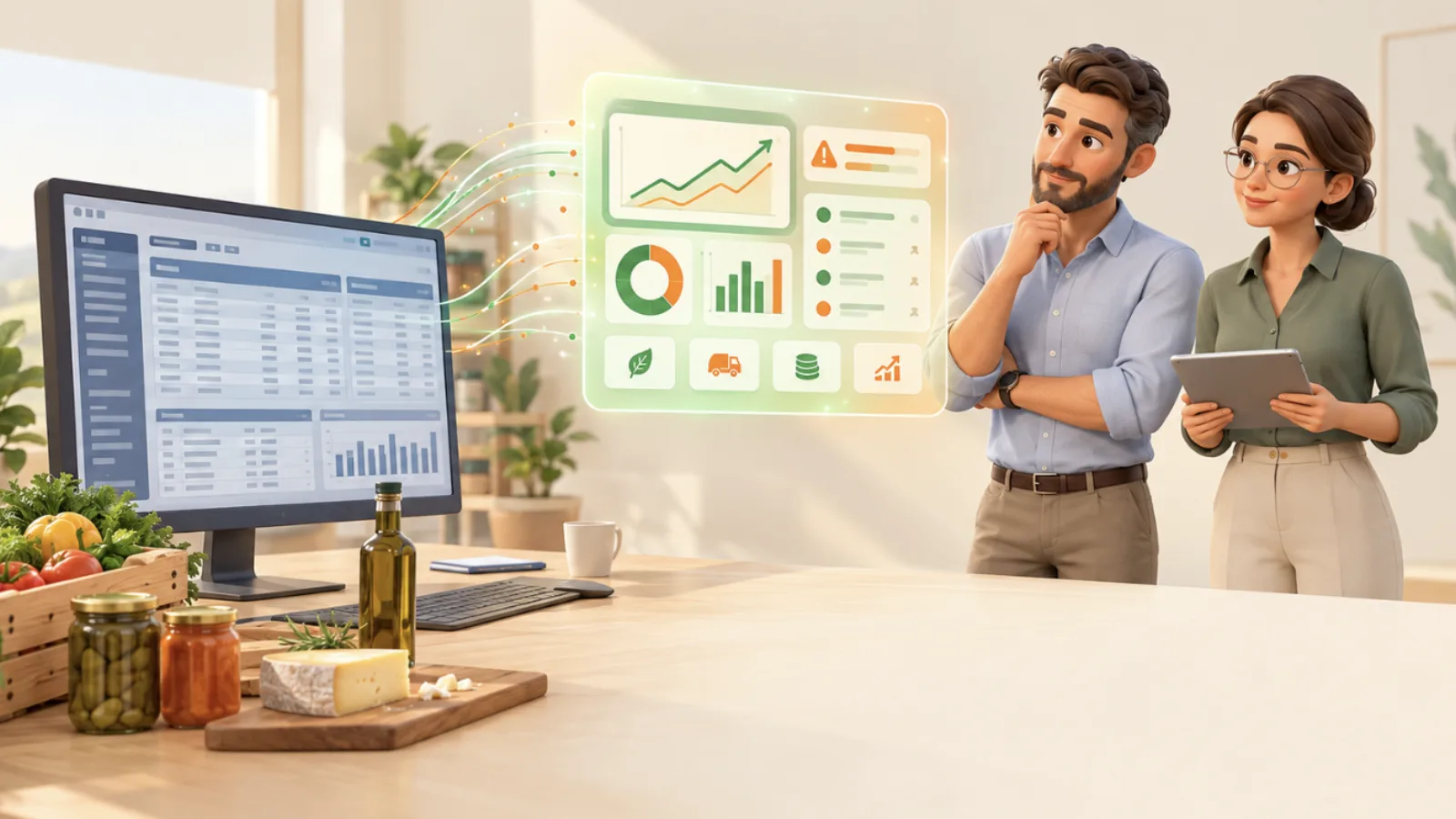
This article deals with another use of AI: agents that read your commercial and financial data, detect what changes, and send you actionable summaries. A far more accessible use, and one that is starting to spread through French SMEs at a pace the figures make hard to ignore.
AI adoption in SMEs: a real acceleration
In 2025, 26% of French small and mid-sized businesses use an artificial intelligence solution. That figure may look modest — but what matters is its progression: it stood at 13% in 2024. In one year, the adoption rate doubled, according to the France Num 2025 barometer.
This momentum is partly explained by tools becoming democratised. AI is no longer reserved for companies with data scientists or dedicated technical teams. Business solutions now embed automated analysis capabilities accessible directly from a browser, with no particular technical skill.
For a food industry SME leader, the question is therefore no longer "is AI relevant to my sector?" — it has become "which use of AI is concretely useful for my business, and how does it work?"
Classic AI vs AI agent: a distinction that matters
Before going further, a clarification is needed on what the term "AI agent" covers, because the confusion is common.
Classic AI answers a question when you ask one. You open a tool, you type a query, you get an answer. That is useful, but it requires you to know which question to ask — and to remember to ask it.
An AI agent works differently. It continuously monitors a set of data, detects changes or anomalies according to criteria you have defined, and sends you a summary or an alert without you having to ask for anything. It acts semi-autonomously: it does not replace your judgement, but it does the monitoring and consolidation work that would otherwise take several hours a week.
| Classic AI | AI agent | |
|---|---|---|
| How it works | Reactive — answers when questioned | Proactive — monitors and alerts |
| What you have to do | Ask the right question | Define the criteria up front |
| Main value | Answer a specific question | Detect what you did not think to look for |
Key takeaway
an AI agent does not replace human decision-making. It removes the time spent collecting, cross-referencing and consolidating data so that the decision can be taken faster and on more reliable foundations.
Three concrete use cases for a food industry SME
1. The automatic commercial summary
In most food industry SMEs, tracking how customer orders evolve means regularly cross-referencing several files: CRM or ERP exports, sales tracking spreadsheets, feedback from the sales teams. That consolidation work takes time — often several hours a week — and produces figures reflecting a situation that is already several days old.
An agent configured to monitor that data can automatically produce, every Monday morning, a summary of this kind: which customers ordered less than their usual pace over the past two weeks, on which references, and with what change compared with the same period last year.
This is not information you could not have obtained manually. It is information you would probably have obtained too late, or not at all, because other priorities would have taken over.
2. Real-time margin alerts
Take a common situation: the price of a key ingredient rises 7% on the market. How long before that shows up in your accounts? In most SMEs, the answer is: at month-end close, sometimes quarter-end. In the meantime, you have carried on producing and selling references whose margin has mechanically fallen, without knowing it.
An agent configured on your purchasing data and your cost prices can detect that variation as soon as it happens and immediately tell you which references fall below your target profitability threshold. You can then act — start a price review, adjust a production volume, trigger a contractual clause — before the impact is visible in your accounts.
Responsiveness, in a sector where production costs are rising across every line for 64% of businesses according to ANIA, has become a competitive advantage in its own right.
3. Profitability analysis by customer
Not all your customers contribute the same way to your margin. A customer generating 15% of your revenue but ordering exclusively low-margin references, with complex logistics and long payment terms, may perfectly well have a negative net contribution once all costs are taken into account.
Identifying these situations manually is tedious. It means cross-referencing sales, production, logistics and finance data that generally live in different tools. An agent can automate that consolidation and regularly produce a ranking of your customers by real contribution to margin — not by revenue.
That information changes commercial priorities. It lets you concentrate retention effort on strategically profitable customers, and start pricing discussions where they are needed.
What AI agents do not do
It would be misleading to present these tools without stating their real limits.
They do not work without reliable input data. An agent monitoring your purchasing data can only be useful if that data is correctly maintained. A poorly filled ERP or desynchronised spreadsheets will produce inaccurate summaries. Data quality remains the prerequisite for any automated analysis system.
They do not replace the leader's judgement. An agent can tell you a customer is ordering less. It cannot know whether that is because they are going through a temporary difficulty, because they are testing a competitor, or because they are preparing a tender. Interpreting the context remains human.
They are not operational immediately. A configuration phase is needed to define which data to monitor, which thresholds trigger alerts, and in what format you want to receive the summaries. That phase requires an initial investment — generally a few days of work with a provider or a software publisher.
Key takeaway
the three conditions for an AI agent to be genuinely useful in a food industry SME — correctly maintained data, monitoring criteria properly defined from the start, and a leader committed to acting on the alerts they receive.
Why the timing is right
Two developments make this subject particularly topical for food industry SMEs in 2025 and 2026.
The first is economic. In a context where production costs are rising across every line and selling prices can no longer follow, decisions taken too late are expensive. The responsiveness AI agents make possible — by shortening the delay between a problem appearing and being detected — has direct financial value.
The second is technological. According to Gartner data, applications embedding AI agents will go from 1% in 2024 to 33% in 2028. This is not a marginal trend: it is an ongoing transformation of the professional software market. SMEs starting to engage with it today gain a head start on the adoption curve — and avoid having to catch up in a hurry in three years.
Where to start concretely
Identify a repetitive consolidation task. Which report or dashboard do you produce manually every week, whose production takes time without creating value in itself? That is generally where automation delivers the most visible gain fastest.
Define two or three priority alerts. In which situations would you have liked to be warned earlier over the past six months? A drop in orders not detected in time, a cost increase that ate into the margin before you saw it, a customer whose buying behaviour had changed without anyone flagging it. Those situations define your first alerts.
Choose a tool that connects to your existing data. You do not need to change ERP or rebuild your information system. Current solutions are designed to connect to existing tools — ERP, Excel files, CRM exports — and produce summaries from that data without migration.
Going further
AI agents are a lever for operational efficiency, but their real impact depends on the quality of the management already in place. An SME that does not yet track its margins by product or by customer will get little from an agent configured to monitor those indicators — because the data does not yet exist in the right form.
That is why putting data-driven management in place is, in most cases, the prerequisite for a relevant use of AI agents. The two subjects are linked: agents amplify the value of management that is already structured.
Want to see how AI agents can fit concretely into your commercial and financial management? Book an Agrolytics demo — we show you in 30 minutes what this kind of automation can produce on your data.
Ready to take control of your data?
Book a 30-minute demo and see what Agrolytics can do for you.
Book a demo