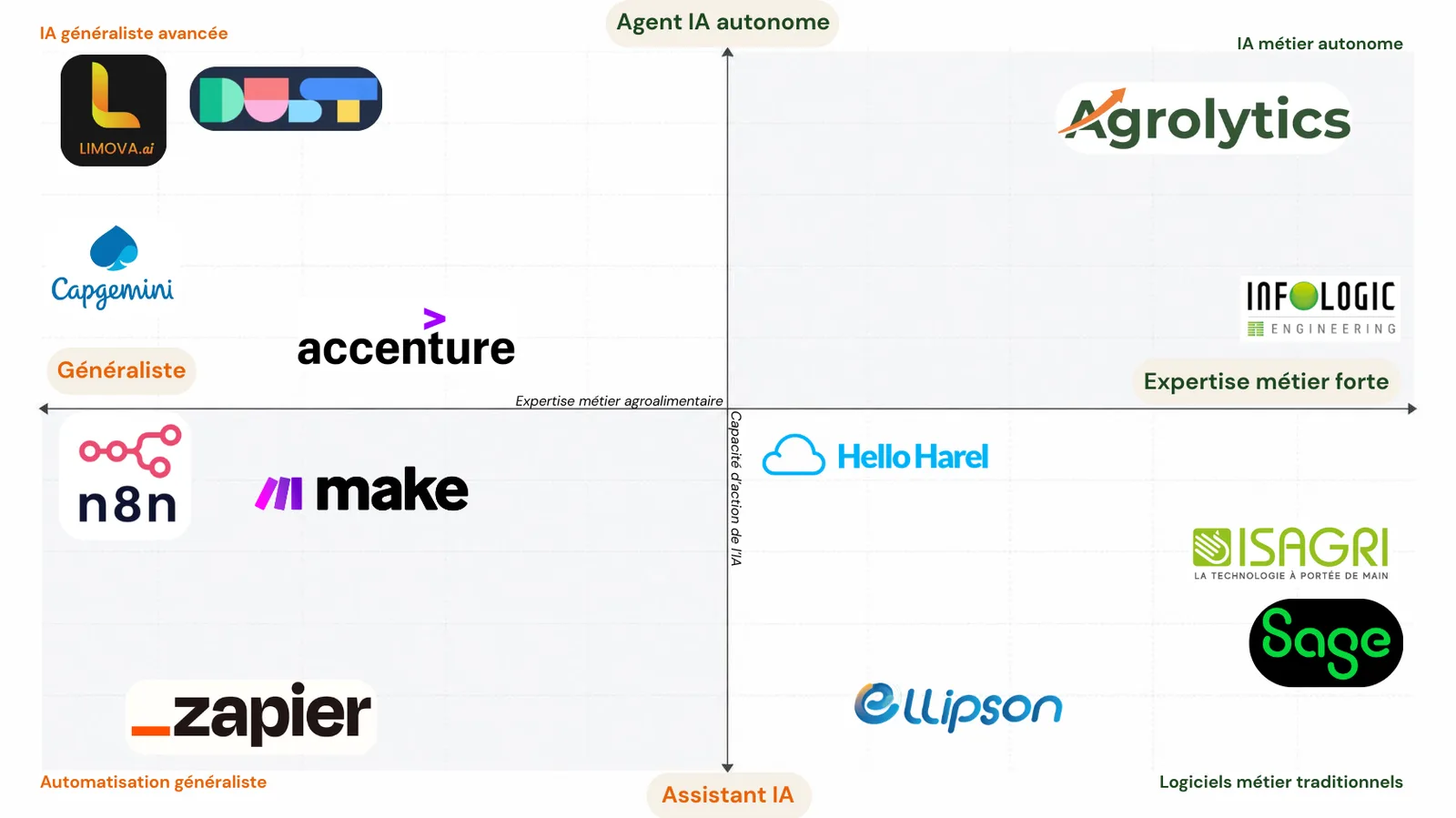
Four families of solutions, an open scoring grid, a verdict by profile. Including where we do not win.
The short verdict
No time to read it all? Here is the essential.
- Agrolytics wins on food industry depth, real agent autonomy, interconnection with your existing tools and value for money. The best choice for a food business that wants to manage its operations without replacing its information system. Overall score: 4.0/5.
- Food industry ERPs + AI (Infologic, Akanea) win on regulatory traceability, production planning and support. The best choice if you are changing ERP anyway and HACCP/IFS compliance comes first. Score: 3.6/5.
- Generalist consultancies (Capgemini, Accenture, Sopra Steria) win on bespoke work, but from €15,000 and several weeks of scoping. Reserved for large budgets. Score: 2.9/5.
- Generalist AI agents (Limova, Dust, Lindy) win on ease of adoption and entry price, but do not know your trade. For cross-functional automation, not for food industry management. Score: 2.4/5.
The detail, criterion by criterion, below.
The methodology
Eleven criteria, a weight for each, a score from 1 to 5 per family. Eight criteria form a common base. One criterion covers interconnection with external tools. Two criteria are specific to the food industry. The weights add up to 100%.
We publish one of the solutions compared. That is precisely why the grid is quantified and why every score rests on a verifiable fact. Dispute a score if you like: you can check it.
The table
| # | Criterion | Weight | Food ERP + AI | Generalist agents | Consultancies | Agrolytics |
|---|---|---|---|---|---|---|
| 1 | Reliability of results | 18% | 4/5 | 2.5/5 | 3.5/5 | 4/5 |
| 2 | Food industry depth | 14% | 4/5 | 1.5/5 | 2.5/5 | 4.5/5 |
| 3 | Integrations | 13% | 4.5/5 | 2/5 | 3.5/5 | 4/5 |
| 4 | Autonomy | 9% | 2.5/5 | 3.5/5 | 3/5 | 4/5 |
| 5 | Ease of adoption | 9% | 3/5 | 4/5 | 2/5 | 4/5 |
| 6 | Security & compliance | 9% | 4/5 | 2.5/5 | 4/5 | 4/5 |
| 7 | Support & guidance | 9% | 4.5/5 | 3/5 | 4/5 | 3.5/5 |
| 8 | Value for money | 9% | 3/5 | 3.5/5 | 2/5 | 4/5 |
| 9 | External tool interconnection | 10% | 2/5 | 3.5/5 | 3/5 | 4.5/5 |
| 10 | ERP integration & traceability | 5% | 4.5/5 | 1/5 | 2.5/5 | 3.5/5 |
| 11 | Production / supply planning | 5% | 4/5 | 1/5 | 2/5 | 2.5/5 |
| — | Weighted overall score | 100% | 3.6 | 2.4 | 2.9 | 4.0 |
Food ERP + AI: Infologic, Akanea, Isagri — 3.6/5
These publishers have known the food industry for forty years. Their software already handles batch traceability, HACCP, IFS and BRC standards, production and logistics. The AI they add builds on that sector expertise, which is their main strength. That is what earns them the best scores on traceability (4.5/5), production planning (4/5) and support, carried by an established and dense network (4.5/5).
The nature of that AI is worth clarifying. At Infologic, it takes the form of semantic document search and a translation agent. At Akanea, of character recognition and automatic order entry. These are assistance functions, useful day to day, but distinct from an agent that analyses sales by channel and formulates a recommendation. That explains the score of 2.5/5 on autonomy, against 4/5 for a solution that carries the analysis through end to end.
Their lowest score is on interconnection (2/5). An ERP is designed to centralise data in its own environment, which makes connecting to third-party tools already in place more complex. That is a structural feature of their model, and it is the main gap with the other solutions scored here.
Generalist AI agents: Limova, Dust, Lindy — 2.4/5
These platforms stand out for their accessibility: you activate an agent in a few clicks, with no technical skill. At Limova, prices range from roughly €70 to €120 excl. VAT per month depending on the plan, for a broad catalogue covering prospecting, social media, accounting or recruitment. That earns them good scores on ease of adoption (4/5) and entry price (3.5/5), making them a relevant starting point for a very small business looking to automate cross-functional tasks.
Their limit lies in their generalist nature. On food industry depth, they score 1.5/5: an agent designed for cross-functional uses does not account for raw material seasonality, retailer framework contracts or the channel margins specific to the food industry. Integration focuses on CRM, emailing and social media, with no connection to trade ERPs (2/5 on integrations, 1/5 on traceability). Finally, several of these platforms do not publicly disclose the underlying AI model, a point to examine from a data sovereignty angle (2.5/5 on security).
Generalist consultancies: Capgemini, Accenture, Sopra Steria — 2.9/5
Large IT services firms develop bespoke agents to large-account security standards (4/5 on security, 4/5 on guidance). For a precise need and a suitable budget, they bring delivery capacity few players can match.
Their business model remains oriented towards large projects. A project generally starts around €15,000, with a senior consultant day rate of €800 to €1,500 and several weeks of scoping before the first deliverables, hence the scores of 2/5 on ease of adoption and value for money. Food industry expertise depends on the consultant assigned to the file rather than on native specialisation (2.5/5 on food industry depth). The deliverable is also an agent defined for a given project, with no product continuity from one engagement to the next.
Agrolytics — 4.0/5
In a word: built for the food industry, plugs into what you already have, from €69 excl. VAT per month.
We are an AI agent platform designed from the outset for food industry SMEs. Our agents Marc (sales) and Sophie (purchasing, margins) are rooted in your trade, not adapted at the edges: 4.5/5 on food industry depth, the best score in the comparison. Autonomy goes as far as the full analysis, not just assistance (4/5).
Our founding stance is interconnection: 4.5/5. From the Business plan at €189 excl. VAT per month, we connect to your ERP via API, CSV, SFTP or direct database, without asking you to replace everything. The Starter plan at €69 excl. VAT per month begins with Excel/CSV import, for organisations that want to take back control of their data without complexity. Pricing is transparent and published, where ERPs and consultancies quote per project (4/5 on value for money).
Our limits, plainly. Traceability remains the domain of ERPs; it is not our trade (3.5/5). Production and supply planning is not yet available: it is a block on our roadmap, not a feature of today (2.5/5). And as a young company, we do not have an established publisher's forty years of perspective on support (3.5/5). We write it down rather than inflate a score.
The criterion that decides it: interconnection
If one criterion sums up the difference in philosophy, it is interconnection (criterion 9). The real question is not "is this tool powerful?" but "will it work with what I already have?".
The ERP answers by centralising: it wants to become the single point, which means bringing your data into its world. Yet a food industry SME rarely works with a single tool: an ERP for orders and stock, treasury software, a raw material price source, sometimes several systems depending on the site. An AI agent's value lies in its ability to read across all of that without requiring you to replace the whole. That is our choice, and it is what tips our score ahead of the ERPs despite their historical lead.
A platform that grows, not a fixed tool
One last point, which does not fit entirely in the table. ERPs add AI blocks to an architecture designed forty years ago, at the pace of their releases. Generalist platforms have a closed catalogue. Consultancies deliver one agent per project, with no follow-on.
Agrolytics starts from two native trade agents and rests on a foundation designed to host others, at the same level of food industry specialisation. What you adopt is not an isolated feature but a platform intended to cover progressively more of your management challenges. A difference in nature, not in degree.
Which solution for which profile?
There is no best solution in absolute terms. There is the right one for your situation.
Choose a food industry ERP + AI if your priority is regulatory traceability and production planning, if you accept a centralised environment, and bearing in mind that the AI there evolves at the pace of ERP updates.
Choose a generalist agent if your need is cross-functional rather than food-specific (content, prospecting, basic admin), with a tight budget and the desire to test without commitment. Do not count on it to understand your trade in depth.
Choose a consultancy if you have a very particular need, a five-figure budget minimum, a team to carry a specification, and you accept several weeks before the first results, for an agent delivered per project rather than a platform that enriches over time.
Choose Agrolytics if you are a food business, you want management rooted in your trade from €69 excl. VAT per month, you want to keep your current tools, and you are looking for a partner whose offer grows over time. Bearing in mind that on traceability and production planning, an ERP will remain more complete today.
Going further
Comparison up to date in 2026. Solutions evolve quickly, and we update this grid regularly. Does a score seem debatable to you? Write to us, and we will make our case.
Ready to take control of your data?
Book a 30-minute demo and see what Agrolytics can do for you.
Book a demo