Why this topic deserves clarifying
Look up what an AI sales agent can do and you almost always land on the same kind of content: automated prospecting, cold email sequences, LinkedIn messages generated by the dozen. Those uses were designed for teams who spend their days looking for new customers, typically in software or services.
A food industry sales team works differently. Its portfolio is made of recurring customers — retail chains, wholesalers, foodservice, independent shops — who order every week or every month. Most of the value is not won in acquisition but in defending and growing existing accounts: spotting the one ordering less, following up with the one who forgot a reference, offering the right range at the right time.
This article is about that use: an AI sales agent connected to the ERP, working on your customers' real history, and what it concretely changes in the daily work of your sales reps and your sales administration team.
Generative assistant or AI sales agent: a distinction that matters
Many sales reps already use AI, often without the company knowing: a sales table pasted into ChatGPT to draft a follow-up, a visit report reworded by an online assistant. It is useful, but it remains a tool that waits to be asked a question and sees nothing beyond what is copied into it.
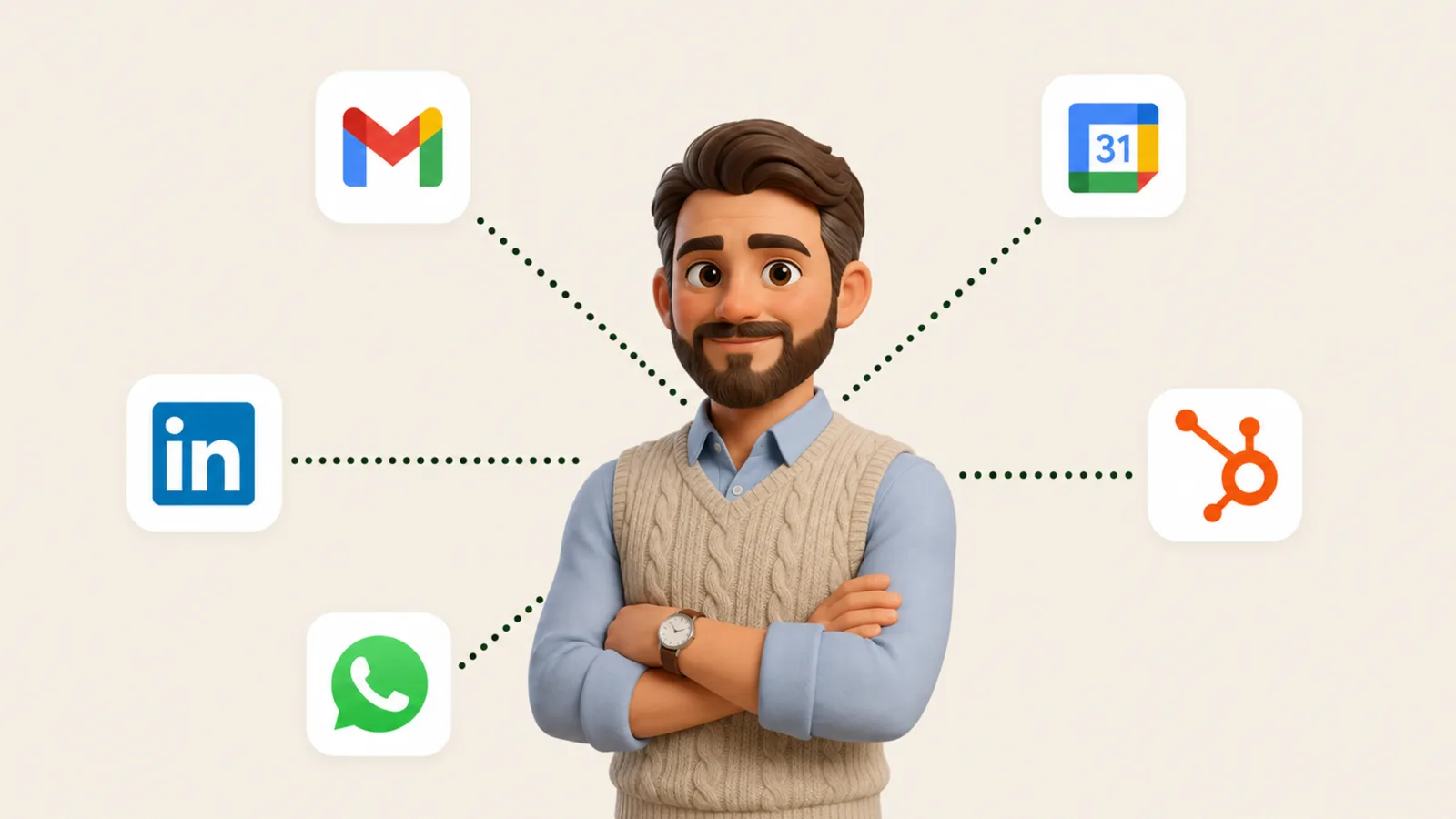
An AI sales agent works differently. It is connected to your ERP and to the team's tools, it reads orders, invoices and customer exchanges, and it works continuously on that data: it detects what changes, prepares follow-ups, keeps records up to date. The sales rep no longer needs to know which question to ask; the agent surfaces what deserves attention. We have detailed that difference in Generative AI vs AI agents: what is the difference for a food industry SME leader?
| Generative assistant | Connected AI sales agent | |
|---|---|---|
| Access to your data | Whatever the rep copies into it | Orders, invoices and exchanges, directly |
| How it works | Reactive — answers when asked | Proactive — monitors, alerts, prepares |
| What it produces | Plausible text | Actions based on the customer's real history |
| What the rep has to do | Know what to ask | Validate and act |
Key takeaway
an AI sales agent is only worth what it is connected to. Cut off from the ERP, it goes back to being a writing assistant; plugged into your customer history, it becomes a colleague who sees what nobody has time to look at.
Five situations where an AI sales agent makes the difference
1. The customer who slips away without warning
In the food industry, a customer never warns you that they are leaving. They simply order a little less: volume down 15% over two months, a weekly order that becomes fortnightly, a range that stops being reordered. Nobody notices, because nobody has time to comb through order details customer by customer.
An agent connected to the ERP learns each customer's normal behaviour and places it in its channel: what is abnormal for a retail chain account is not for a wholesaler or a foodservice customer. As soon as a weak signal appears — frequency slowing, average basket eroding, an unusual payment delay — it alerts the rep in charge of the account.
It is not information the rep could not have found alone. It is information they would have found too late, at the point where winning the account back costs far more than defending it.
2. The follow-up with nothing to say
Everyone knows follow-ups matter. The problem is following up with something to say. An email saying "you haven't ordered for a while" does not convert. A follow-up reminding a customer that they usually reorder a given reference at this time of year, or that a promotion matches their purchase history exactly, is another matter. But personalising to that level across an 80-account portfolio is impossible by hand.
The agent drafts personalised follow-ups customer by customer, based on the products actually ordered and the history of the relationship. It can also prepare a targeted promotion: identify the relevant customers, adapt the message by segment, prepare the sends. The rep keeps control over what goes out, but no longer starts from a blank page.
3. The meeting prepared in the car
Before a meeting, the information always exists, but it is scattered: the last exchange is in a colleague's inbox, the report from the last review is somewhere on a shared drive, and nobody has followed the customer's news. The result: the context is pieced together from memory, five minutes before walking in.
Connected to the mailboxes and the ERP, the agent keeps each customer record up to date: latest exchanges, recent orders, filed visit reports, news about the customer or its market. Preparation goes from twenty minutes of digging to a record that is already ready.
4. The visit report nobody writes
After a visit, someone should write the report, list the actions and update the CRM. In practice it rarely happens, or three days later, once the details have faded. Customer knowledge is lost at the source.
From a two-minute voice note recorded on the way out of the meeting, the agent writes the report, extracts the actions to take with their deadlines and updates the customer record. The company's sales memory builds itself without any data entry.
5. The market watch everyone puts off
Knowing that a competitor is launching a range, that a key customer has changed buyer or that a chain is opening in your area makes the difference between reacting and anticipating. But market watch takes regular time that nobody in a sales team really has.
The agent runs that watch continuously on competitors, customers and prospects, and only surfaces what concerns each rep's portfolio. The information reaches the right person, at a time when it can still be used.
AI for sales teams: what changes in a selling week
Taken one by one, these use cases can seem modest. Put together, they change how the whole sales team's time is spent.
| Task | Without an agent | With an agent connected to the ERP |
|---|---|---|
| Spotting customers in decline | At best in a monthly review | Alert at the first signals |
| Following up | Generic message, often put off | Personalised follow-up ready to validate |
| Preparing a meeting | Twenty minutes across three tools | Customer record already up to date |
| Visit report and actions | Rarely done, or too late | Written from a voice note |
| Watching competitors and customers | Occasional, when someone thinks of it | Continuous, filtered by portfolio |
The first effect is time: our customers observe around 6 hours freed up per week per sales rep or sales admin assistant, which go back into customer relationships. The second is measured in euros — an account defended in time, a follow-up that restarts a volume, a better-targeted promotion. On the Agrolytics home page, a live counter shows what our sales agent has generated for our customers this month.
To put a figure on what that would mean in your business, line by line and with your own data, we have detailed the method in how to calculate the ROI of sales AI in the food industry.
What an AI sales agent does not do
It would be misleading to present these tools without being clear about their real limits.
It does not replace your sales reps. The agent can flag that a customer is ordering less. It cannot know whether that customer is going through a temporary difficulty, testing a competitor or preparing a tender. Reading the context, negotiating and building the relationship remain human.
It does not act without your approval. The agent prepares follow-ups, alerts and reports; the rep decides what goes out, and to whom. It works within the framework you set, not beyond — a principle we developed in our article on data governance and AI strategy.
It does not make up for missing data. If order details are not entered in the ERP, or each customer's channel is not recorded, drop-off detection loses precision. The quality of the history remains the prerequisite.
It is not operational on day one. Connecting to the ERP and mailboxes, then learning each customer's normal behaviour, requires a set-up phase before the first alerts are fully relevant.
Key takeaway
three conditions for an AI sales agent to be genuinely useful — a correctly recorded order history, a team that validates and acts on what the agent surfaces, and a clear framework for what it is allowed to do on its own.
Where to start in practice
List the customers you lost last year. Which accounts stopped ordering, or sharply reduced their volumes, without anyone seeing it coming? Which signals would have shown it three months earlier? Those cases define your first alerts.
Observe a typical week for the team. How many hours go into looking for information, formatting, follow-ups and visit reports? That is where the time saving will be most visible, most quickly.
Check what your ERP already holds. Line-level order details, invoice and payment history, each customer's channel: in most food businesses, this data already exists. There is no need to change tools to use it.
Going further
A sales agent becomes even more valuable when it combines the ERP with other sources — mailboxes, market data, industry news. That is why the most useful AI agents are not limited to your ERP. And to place the sales agent among all the possible uses, we have described what AI agents concretely do for food industry SME leaders.
These are the principles we built Marc on, our AI sales agent, now in production at several food businesses. To see what he would surface from your own order history, book a 30-minute demo, tailored to your sector and with no commitment.
Ready to take control of your data?
Book a 30-minute demo and see what Agrolytics can do for you.
Book a demo